
The Cost of Waiting Until the First Storm Hits
Skip the pre-season check this year and here's what that gamble usually costs: a gust gets under a door with worn seals or loose track brackets, the panels bow or buckle, and the whole assembly can tear away from the wall. Once that happens, wind-driven rain follows the gap straight into the garage, soaking stored boxes, tools, or whatever's parked inside. If the opener's circuit board takes on moisture, you're replacing that too. A blown-out garage door combined with water damage is a far bigger repair than an hour of maintenance would have been, and it usually happens at the worst possible time — during the storm itself, when no one wants to be out fighting with a stuck door in the dark.
Why the Garage Door Is Your Home's Weakest Wall
Every other wall in your house is a continuous run of studs, sheathing, and siding. Your garage door is the largest opening in that envelope, and it's not a wall at all — it's a moving panel assembly held in place by tracks, rollers, and a handful of lag bolts into the framing. When wind pushes against a solid wall, the load spreads across dozens of studs. When wind pushes against a garage door, that same force concentrates on a thinner panel and a track system that was engineered for smooth operation, not for resisting pressure. If the door fails first, wind can get inside the structure and start pushing outward on the roof and walls from the inside, which is a much bigger problem than a dented panel.
This isn't just a hurricane-zone concern. The South Bay gets its own version of this risk every winter: strong, gusty frontal systems moving through ahead of rain, sometimes with sustained wind that rattles anything loose. A door that's been quietly weakening all through the dry months is exactly the kind of thing that fails under that kind of load.
What's Actually Been Happening to Your Door All Summer
After a dry season of heat, dust, and the occasional stretch of wildfire smoke in the air, a few things are working against your door that you may not have noticed:
- Weatherstripping has shrunk and cracked. Rubber seals dry out and lose flexibility after months of heat. By October, the bottom seal and side seals often have gaps you can see daylight through — and that same gap is where wind-driven rain gets in.
- Dust has built up in the rollers and hinges. Dry-season dust mixes with old grease and turns gritty, which adds friction and strain right where you need smooth, controlled movement under wind load.
- Hardware has loosened from months of thermal cycling. Track brackets and lag bolts work slightly looser as the garage heats and cools through the seasons. Small movement adds up, and loose brackets are the first thing to give when wind pushes against the door.
The Pre-Storm Checklist
- Inspect the weatherstripping. Run a hand along the bottom seal and side seals. If it's brittle, cracked, or compressed flat, replace it before the rain starts — this is inexpensive and takes an afternoon.
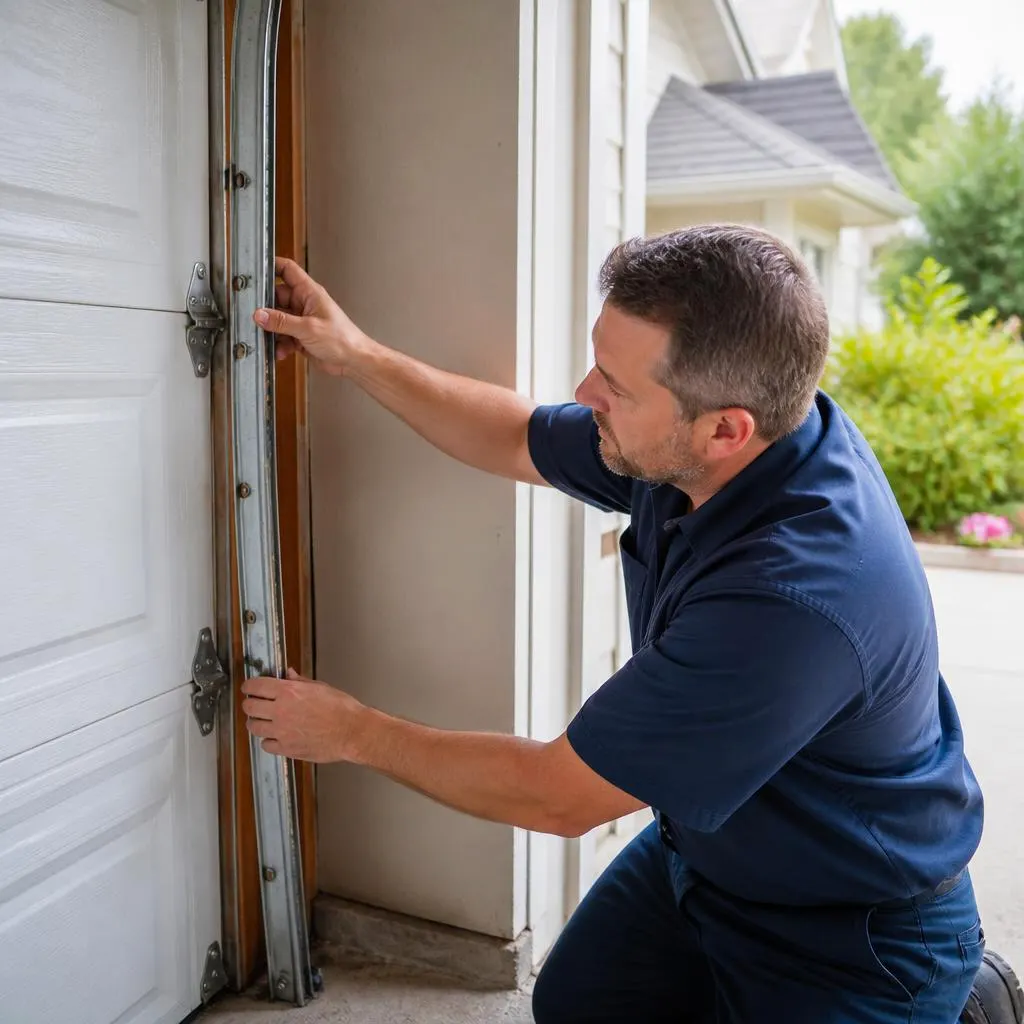
- Check every track bracket and lag bolt. Look for elongated screw holes or brackets that wiggle when you push on them. These need to be re-tightened or re-anchored into solid framing, not just the drywall or trim around it.
- Lubricate rollers, hinges, and the torsion spring with a silicone-based lubricant rather than a general-purpose spray, which tends to attract more dust and grit over time.
- Look closely at the springs. Surface rust, visible gaps between coils, or a door that feels heavier than usual to lift manually are all signs a spring is wearing out. A spring that fails during a storm, when the door is already under extra load, is a safety hazard as well as an inconvenience.
- Confirm your opener has a working battery backup. Winter storms bring power outages, and a door stuck half-open because the power cut out is an open invitation for wind and rain.
- Know where the manual release cord is and make sure it operates smoothly, in case you need to close the door by hand during an outage.
Two Things Worth Doing Together
If your home has had seismic bracing work done — common across this area given the earthquake retrofit standards many houses have gone through — it's worth having that bracing checked alongside your storm prep. Lateral bracing and reinforced wall anchors installed for seismic safety often stiffen the same door assembly that needs to resist wind pressure, so addressing both at once is efficient rather than redundant. And if your home sits closer to the coastal corridor where salt air reaches further inland than people expect, check hardware for corrosion more often than you would elsewhere — salt air accelerates rust on springs, hinges, and exposed fasteners well before they'd normally need attention.
When to Call San Jose Garage Door
If you've found loose track hardware, a spring with visible wear, seals that are beyond a simple fix, or an opener without battery backup, it's worth having a technician look at the whole system before the rain sets in rather than after a storm damages it. San Jose Garage Door handles this kind of pre-season work as part of our garage door maintenance service — checking spring tension, tightening and re-anchoring track hardware, replacing worn weatherstripping, and testing the opener and backup power. If a spring is already showing rust or uneven coils, our spring replacement service gets that handled safely before it becomes a storm-day emergency. And if a storm does catch you off guard with a door that won't open or close, our emergency garage door service is there to get it secured quickly.
If you're in San Jose, Santa Clara, Campbell, Milpitas, Cupertino, Los Gatos, Morgan Hill, or Sunnyvale, call San Jose Garage Door before the next storm front rolls through. We'll check what needs attention and get it handled while the weather still gives us the chance.